Former Hashimoto's Patient: "Your pill is working. That was never the part that was broken."
Eight years on medication with normal labs, and still asleep at my desk by three in the afternoon. Here is what I found when I finally went looking for a reason instead of another treatment.



If you have been told that this is just what Hashimoto's feels like once the labs are normal, you have been misled.
I should know. I spent eight years being told exactly that.
My name is Jennifer Brooks. I was diagnosed with Hashimoto's at 35, after four years of being told it was postpartum, anxiety, stress, and sometimes women your age just feel this way. I started levothyroxine. My TSH came down. My antibodies were confirmed. On paper, I was a treated patient with a managed condition.
I was also still falling asleep at my desk at three in the afternoon.

Over the next eight years I changed brands four times. I added T3. I tried NDT. I went gluten free, then dairy free, then full AIP for eleven months. I took selenium, vitamin D, iron, B12, and a drawer full of thyroid support bottles I could not tell apart. I paid a functional medicine doctor three hundred dollars a visit for two years.
And every appointment ended the same way. My labs were normal. My thyroid was under control. Whatever was left must be something else.
The number was just never the whole problem.
What I Wasn't Supposed to Find
The morning after my last specialist appointment, I opened my laptop and started reading.
For the first time in eight years, I had a direction. Not a new treatment. A reason.
Why did every answer I was given aim at the hormone, the antibodies, or the gut? Why were millions of women taking their pill every single morning, exactly as prescribed, with perfect labs, and still unable to get through an afternoon? And why, when that happened, was the next explanation always something about us rather than something about our bodies?
For weeks I found nothing. I read about conversion. I read about reverse T3. I read about adrenal fatigue and gut permeability and every protocol the internet had built around them. They all had pieces. None of them had the thing that would explain why my body felt the way it did on a lab report that said I was fine.
Then, in my third month of reading, I found a paper I almost closed.
It was in a connective tissue journal I had never heard of. It had nothing to do with endocrinology. And it proposed something I had never once seen mentioned in a thyroid forum, a patient group, or a single appointment.
That the exhaustion, the aching, the heavy legs and the fog were not leftover thyroid symptoms at all.
They were tissue symptoms.
Specifically, a dysfunction in a tissue I had never been taught about. Not in school. Not in a hundred appointments. Not by any of the doctors who had diagnosed and treated me.
My first reaction was skepticism. So I tried to disprove it.
I pulled the references at the bottom of the paper. Then I pulled their references. And over three more weeks, something started clicking into place that I could not unsee.
This was not one fringe paper. It was a wave of research that had only really gained traction since around 2021. For decades before that, the tissue they were studying had been dismissed as packing material. Most doctors were never taught it was a functional system at all.
Then imaging got good enough to see what nobody had been able to see. Real mechanistic papers started getting published. And when I compared what that research described, exhaustion that does not match the activity, stiffness that is worst in the morning, legs that turn to lead on the stairs, a fog that takes the word away mid sentence, it matched my experience more precisely than anything any doctor had ever said to me.
This Tissue Is Called Fascia
If you have never heard of it, you are not alone. Until four years ago, neither had I.
Fascia is the water rich layer of connective tissue that fills the space between everything else in the body. It sits directly under your skin. Pull the skin back and the first thing you would see is not muscle. It is fascia.
It wraps every muscle. It holds nearly every nerve in place. It runs alongside every blood vessel, from your scalp to the soles of your feet, as one continuous unbroken sheet.
It is the thing that holds you together. Literally.

You do not notice it. Your body just works. You move without thinking about it. You sleep and wake up restored.
It dries out. It thickens. Its layers stick together and set. And then it compresses every muscle and every nerve inside it.
Think about a wetsuit. Brand new and wet, it stretches. It moves with you.
Now hang that same wetsuit in a garage and forget about it for a year. The material dries out. It shrinks. It tightens around whatever is inside it.
That is what had been happening to my fascia. For years. Tightening around my muscles. Tightening around my nerves. Tightening so slowly I could never point to the day it started.

Every Symptom Suddenly Made Sense
Once I understood what fascia actually does, the list of symptoms I had been handed other names for stopped being random.
A muscle working inside a layer that has set is working against resistance with every single movement. All day. By evening you are not tired because you did too much. You are tired because everything cost more than it was supposed to. And a nervous system being pressed on all day does not drop into real rest at night. Sleep still happens. Recovery does not.
It is not that the hormone is still low. It is that the tissue never recovered.
Fascia is one continuous sheet, so when it densifies it does not do it in one spot. It does it everywhere at once. That is why the aching is not in a joint, and why it is worst first thing in the morning, after the layer has settled overnight and has to be warmed and worked loose before anything moves properly.
It is not something else. It is the muscles working inside a layer that has set.
A muscle wrapped in densified fascia cannot move through its full range, so it produces less strength no matter how much muscle is actually there. Two hands to get out of a chair. Resting after a shower. Arms tired from lifting a pot.
It is not that you are out of shape. It is that the muscle cannot be used fully.
The fascia at the back of the neck and the base of the skull surrounds the nerves and the blood vessels that supply the brain. When that layer tightens, flow and signal get compromised. And a nervous system that never switches off never clears.
It is not a failing mind. It is a mind running on a body that has not been allowed to stand down in years.

Here Is Why It Happens
Once I understood the mechanism, the obvious question was what caused the fascia to densify in the first place.
The answer is the years before the diagnosis.
Most people go five, ten, fifteen years with a low thyroid before anyone catches it. The tiredness gets called stress. The aching gets called age. The labs do not get ordered, or they come back fine, while the hormone quietly runs low year after year.
And a body running on low thyroid is a body under threat.
During a sustained threat, the body does what it has always done. To keep the organs that cannot fail running, the heart, the brain, the lungs, it redirects its supply of water and nutrients toward them and cuts everything it can afford to run short.
The fascia is cut first.

So through every one of those undiagnosed years, the layer wrapped around my muscles and nerves was running on a fraction of what it needed. Drying. Thickening. Setting. A little more every year.
Then somebody finally caught it. The diagnosis came. The medication came. The hormone came back and the labs went normal.
The threat was over.
But the supply to the fascia never fully came back. After years of running short, it gets enough to stay alive and not enough to return to the soft hydrated state it started in. So it stays dense. And a dense layer that never regains its supply does not loosen on its own.
That is why the symptoms did not leave when my labs normalized.
A survey of more than 12,000 treated patients asked those who said they were still struggling what was bothering them most. Fatigue came first at 77 percent, ahead of weight, memory and mood. Separately, researchers who followed 356 patients after starting levothyroxine found that at every follow up, about 27 percent still had symptoms while their TSH was normal. Which means feeling unwell on a normal lab report is not rare, and it is not imagined. It is a documented pattern.
And doctors have known for decades that low thyroid changes connective tissue. It is in every textbook. The cells that build and maintain that tissue answer directly to thyroid hormone, and when the hormone runs low those cells change what they produce. It is the documented reason severe low thyroid changes the skin, and the reason nerve compression problems are so common in untreated low thyroid. The changed tissue physically presses on the nerve running through it.
That part is settled science. What is new is what it means for how you feel now.
Why Nobody Told Me
Not because it is hidden. The research has been building for years. Not because it is controversial. The mechanism is well documented.
The reason is simpler, and worse.
The compounds fascia needs to rehydrate are natural. No pharmaceutical company can own them. No pharmaceutical company can make billions selling them. Which means there is no economic incentive for anyone to fund the research, educate the doctors, or push it into mainstream medicine. So nobody does.
Everything I was ever given for Hashimoto's was aimed at the hormone, the immune system, or the gut. The dose changes and the T3 and the NDT work on the hormone. The selenium and the diets work on the immune system and the gut. The vitamins patch the shortfalls the low years left behind.
Every one of them was doing its job.

Not one of them was aimed at the tissue.
The Solution Is Almost Insulting in How Obvious It Is
If the fascia densified because it lost its supply, you put the supply back.
That is it.
Think about a bodybuilder who never eats protein. He can spend four hours a day in the gym, train perfectly, never miss a session, and still stay skinny. Not because he is not working hard enough. Because he is not giving his body the raw material to build with.
This is the same. You can do the yoga. You can take the walks. You can stretch and foam roll and drink your water and force yourself through every gentle workout the wellness internet recommends. You are working a tissue that has been starved of its raw materials for years.
There is no secret and no breakthrough technology. There is a tissue that stops working properly when its nutrient supply runs out, and starts working properly again when that supply is restored.
Densification is not scarring and not permanent. Fascia researchers have documented that when the hyaluronic acid layer inside the fascia regains its water content, the tissue's layers glide over each other again and its stiffness drops, taking the pressure off the structures inside it. The state the fascia is in can change. It was never a life sentence.
What is missing is the delivery.
The specific compounds fascia needs are not in a normal diet in meaningful amounts. You cannot eat your way to hydrated fascia. And the generic joint supplements on drugstore shelves are formulated for cartilage, using doses and molecular weights that never reach fascial tissue at all.
Which means the answer had been sitting in peer reviewed journals while nobody built a formulation that delivered it.
And until very recently, nobody had ever actually built it.
So I Started Cold-Emailing the Specialists

Once I understood what fascia needed, I went looking for a product that delivered it. I assumed somebody had to be making it. The science was proven. The mechanism was clear.
I looked everywhere.
Every joint supplement on the shelf used glucosamine and chondroitin, compounds developed for cartilage in the 1990s that have nothing to do with fascia. The handful of fascial health products I could find online were rebottled collagen with new marketing. Not one product on the market was built around what the research actually said fascia needed.
Nobody had built it. Not because it was impossible. Because there was no money in it.
So I decided to build it myself.
I knew I was not qualified to do it alone. I am a former English teacher, not a physician and not a chemist. So I started cold emailing the specialists whose papers I had been staring at on the wall above my desk. Most never replied. A few responded politely to say they could not help. One or two told me, in the way academics do when they are trying to be kind, that I was probably in over my head.
Then one of them replied with three paragraphs.
His name was Dr. Nathan Reeves.


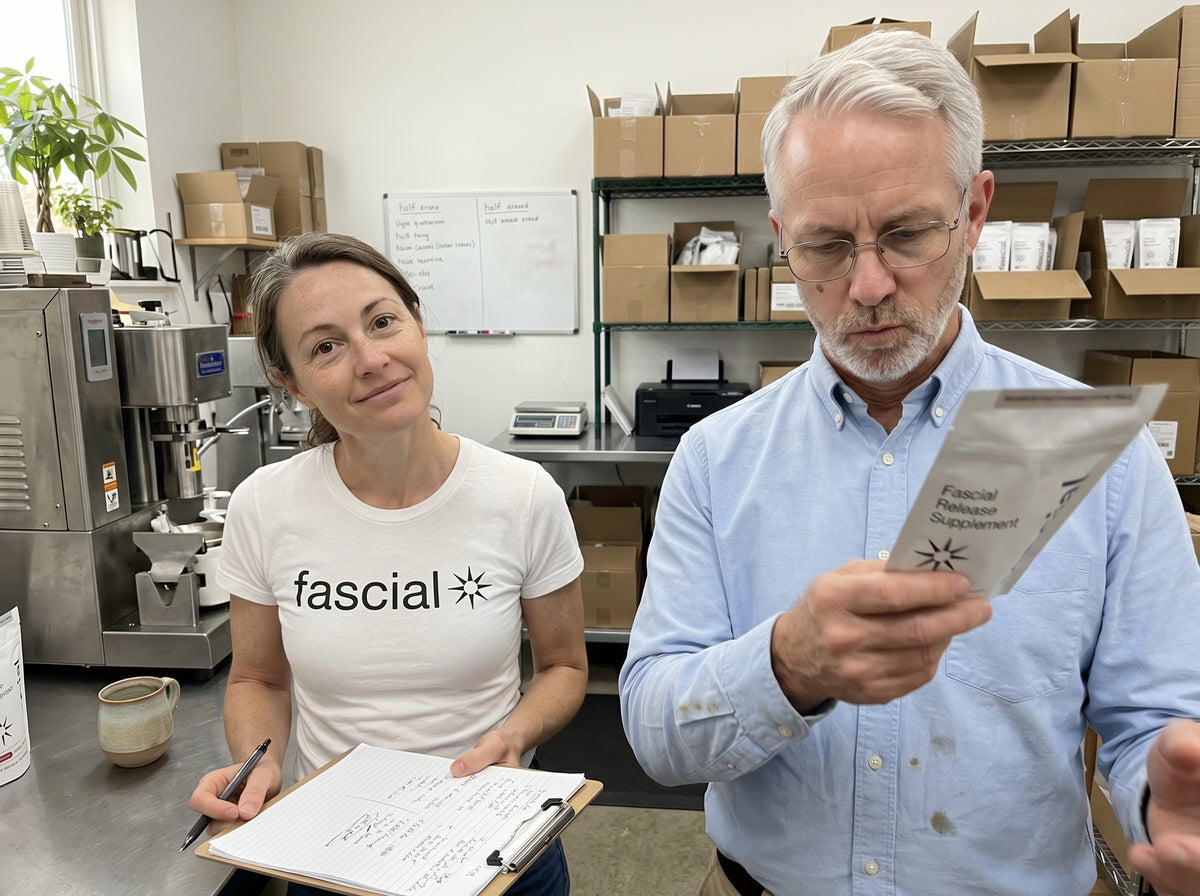
He is a physiatrist, a physical medicine and rehabilitation doctor, with twenty years of clinical experience and a subspecialty in myofascial pain. The last eight of those years he had spent focused almost entirely on fascial therapy. He read my email late on a Saturday and replied Sunday morning.
He said he had seen hundreds of patients like me. Treated thyroid, normal labs, and a body that still would not cooperate. He said he had been watching the research emerge for years, and he had been waiting for somebody outside the pharmaceutical world to take it seriously enough to do something about it.
A fifteen minute phone call turned into two hours. By the end of it, I had a partner.
What followed was the hardest eleven months of my life.
We were not reformulating an existing product. There was no existing product. We were building from scratch. Which compounds reach deep connective tissue when taken orally. Which molecular weights the body can actually absorb. Which concentrations the studies had used to produce real results.
We refused to compromise on any of it. The wrong form of hyaluronic acid would never reach the tissue. The wrong source of silica would not be bioavailable. The wrong concentration of proteolytic enzymes would do nothing at all.
Dr. Reeves brought the clinical expertise, the formulation knowledge, and the manufacturing relationships. I brought a body that had been exhausted for eight years on a perfect lab report and could tell within a few weeks whether a version was doing anything at all.
We went through seven formulations before we landed on one that worked.
Some did nothing. Some did a little. One made me nauseous for a week. The fifth started to move the needle. By the seventh, something happened that I had not felt in almost a decade.
I walked up the stairs without planning the route.
I sat through an entire dinner with my kids without calculating how long I could stay at the table.


Small things. I know. But after eight years of measuring every day by how much of it I was going to survive, small things are what you notice first.
By month six I was doing things I had not done in a decade. If I were not running a business full time now, I would be back in a classroom teaching.
We Called It TrueForm®
It is the first supplement built specifically to rehydrate densified fascia. Not joint health. Not general inflammation. Not wellness. Just the mechanism the research has been pointing at for years, and the compounds the body stopped supplying during the low years.
One thing should be said plainly before anything else.
TrueForm® is not a thyroid supplement. It does nothing to the thyroid, the antibodies or the dose. It is the first thing offered to Hashimoto's patients that is not trying to be their medication.

That is deliberate. The morning belongs to the thyroid pill, taken exactly as prescribed, exactly as always. TrueForm® goes later so nothing new sits anywhere near it. Nothing changes about how the medication is taken.
Now look. I know what you are probably thinking. You have tried a dozen things that promised to work. You have been disappointed by every one of them. You are skeptical, and you should be.
So here is what I will say. Most of what is out there was not built for this. Most joint supplements are formulated for cartilage in your knees. Most fascia products are repackaged collagen with a new marketing angle. The handful that include any of the right ingredients underdose them so badly they never reach the tissue.
Not one of them was built for what is actually happening in your body.
This was.
The Numbers So Far
When Dr. Reeves and I shipped the first production run, we tracked an initial cohort of 1,092 adults with Hashimoto's. Every one of them on stable thyroid medication, with normal labs, and every one of them still symptomatic. All of them stayed on their medication exactly as prescribed for the full ninety days.
These are not industry funded numbers. There is no pharma company behind us and no agency optimising the survey questions. Every response came from a real person filling out a form on their phone, in their own words, on their own time.

I Don't Trust Supplement Reviews. You Probably Don't Either.
So instead of handing you a dozen five star quotes, here is what has been landing in our inbox.


None of them expected it to work. All of them had already tried something else that did not. Every one of them was at the point most people reach right before they give up.
They did not give up. They just found the one thing nobody had ever built for them.
Look, I get it. You have been burned before. Supplements that did nothing. Diets that took everything off the table and gave nothing back. Appointments that ended with a pamphlet and a different version of advice you had already heard four times.
No forms. No hoops. No store credit. No asking you to prove you used it right. Just email the team and say it did not work. We refund your money and you keep the pouches.
Why am I willing to do that? Because this is the exact formula I take every morning. I am not selling something I have not lived inside of.
Because I spent eleven months and seven failed formulations getting here, and Dr. Reeves staked twenty years of clinical reputation on the one we landed on.
And because I care more about people getting their lives back than I do about turning a profit on a pouch. I built this for the version of myself who spent eight years with no answer.
Safe Alongside Everything Already in Your Routine
TrueForm® is compatible with everything currently used for Hashimoto's. Levothyroxine in every brand, NDT, added T3, selenium, vitamin D, iron, B12, LDN, and every prescription in the standard pool. Because the formulation is made entirely from natural ingredients, there is no need to come off anything to begin.
Anyone on a blood thinner, and anyone pregnant or nursing, should check with their provider first.
And one thing worth saying plainly. TrueForm® is not a treatment for Hashimoto's and it is not a thyroid medication. Keep taking your levothyroxine exactly as prescribed, and any new or rapidly worsening symptom needs a doctor, not a supplement.
Why Starting Sooner Matters
The state the fascia is in runs in one direction. Every year it goes without its supply, it dries a little more. Every bit of drying is a tighter squeeze on the muscles and the nerves. Every tightening asks more of a body that already gets back less than it spends.
That is what sits behind what so many people describe as their baseline quietly dropping. The walks getting shorter. The afternoons ending earlier. The good days getting rarer. Year over year, on the same dose, with the same normal labs.
Fascia does not rehydrate on its own. Left alone it only continues to densify.
Which means the state your tissue is in today is the easiest it will ever be to rehydrate.

What to Do Next
You close this tab. You go back to managing it. You try the next thing someone in your support group recommends. You wait for the next appointment. You hope something changes.
That is a real option. It is the option I chose for eight years.
But every month the fascia keeps tightening is a month it gets a little harder to reverse, and a little further from the body you used to have.
You check if it is in stock and order today. We manufacture in small batches and demand has consistently run ahead of supply. When a batch sells out the next one takes six to eight weeks.
If it is available, you will have it in two to three days.
Our most common order is the six month supply. It is the full protocol, and it is where the shifts actually compound. The guarantee covers every penny either way.
TrueForm® is only available at tryfascial.com. If it shows up anywhere else, it isn't the real thing. Here's what's going on:
- Scammers have listed fake "TrueForm® supplements" on Amazon copying the name and logo.
- These counterfeits are made overseas and don't contain the actual TrueForm® ingredients.
- Many are never shipped at all. Buyers are charged and receive nothing.
- Fascial Labs is actively working to get these listings removed.
The genuine, USA-made TrueForm® is sold in one place only: tryfascial.com
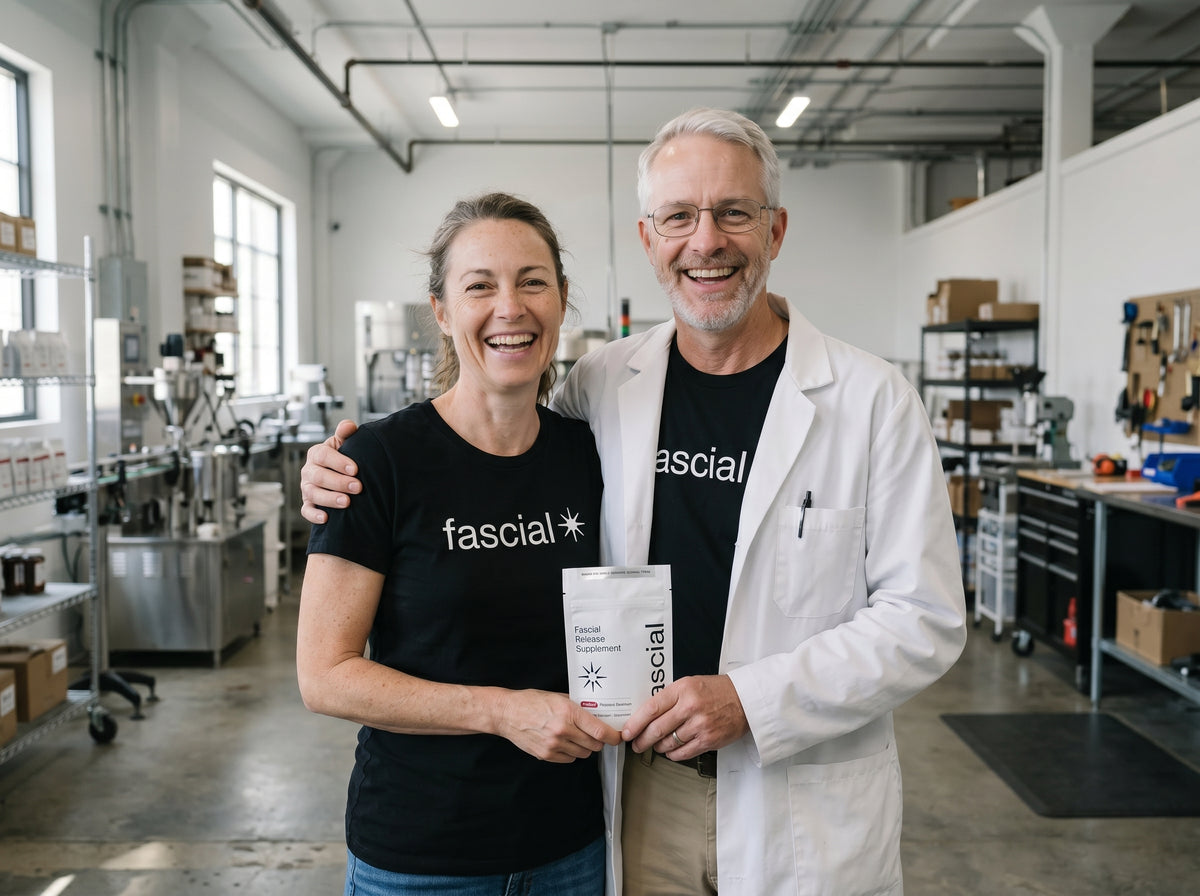
Jennifer had Hashimoto's for eight years, on medication with normal labs, before she found the research that explained why she still felt the way she did. She spent another six months reading every paper she could find before she started cold emailing the specialists behind them. Dr. Reeves was the one who replied. He is a physiatrist with twenty years of clinical experience and a subspecialty in myofascial pain. They spent eleven months and seven failed formulations getting TrueForm® right.

- Stecco C, et al. The fascia: the forgotten structure. Ital J Anat Embryol. 2011.
- Stecco A, et al. Fascial densification: pathophysiology and clinical relevance in myofascial pain. J Bodyw Mov Ther. 2018.
- Langevin HM, et al. Reduced thoracolumbar fascia shear strain in human chronic low back pain. BMC Musculoskelet Disord. 2011.
- Pratt RL. Hyaluronan and the fascial frontier. Int J Mol Sci. 2021.
- Stecco C, et al. Fascial or muscle stiffness? A narrative review. J Anat. 2021.
- Peterson SJ, et al. Persistent symptoms in levothyroxine-treated hypothyroidism. Endocrine Practice. 2023.
- Smith TJ, et al. Connective tissue, glycosaminoglycans, and diseases of the thyroid. Endocrine Reviews. 1989.
- Thyroid hormone and fibroblast function. Frontiers in Endocrinology. 2023.
- Shear wave elastography in Hashimoto's thyroiditis. Journal of Ultrasound. 2020.
- Pooled elastography review in autoimmune thyroiditis. Ultrasound in Medicine & Biology. 2025.
- Hypothyroid Myopathy. StatPearls. 2024.
- Jurkic LM, et al. Biological and therapeutic effects of orthosilicic acid and silica supplementation in connective tissue regeneration. Nutr Metab (Lond). 2013.
- Bhagat S, et al. Serrapeptase as a proteolytic enzyme in the treatment of musculoskeletal inflammation. Int J Surg. 2013.
- Cowman MK, et al. The content and size of hyaluronan in biological fluids and tissues. Front Immunol. 2015.
© 2026 Health & Science Journal. All rights reserved.
These statements have not been evaluated by the Food and Drug Administration. This product is not intended to diagnose, treat, cure or prevent any disease. Individual results vary.