A 2026 session on a new root cause, published in full. There was an empty chair in the room the entire time, and it was not for any of them.


For fifty years, fibromyalgia has been treated as a nervous system problem.
Pain medications. Antidepressants. The same short list of prescriptions, handed to millions of women for decades, all of them built on one theory: that the brain has somehow rewired itself to manufacture pain that isn't really there. And when those don't work, most women are left with little more than a shrug, and the unspoken implication that the problem is somehow theirs to explain.
But a nervous system doesn't just rewire itself for no reason. Something has to cause that. And numbing a signal with pain meds and antidepressants instead of finding what triggered it was never really a fix. It was the best medicine could do with an incomplete picture.
In 2026, that picture is finally starting to look complete.
Thousands of women are finally getting their lives back from fibromyalgia, and reclaiming the women they thought they had lost for good. Not through a new prescription, but through a discovery that traces back to something that entered the body and permanently altered how it functions. It came, it did its damage, and the change it left behind never resolved on its own, quietly driving their symptoms ever since.
And once that discovery is understood, fibromyalgia stops looking like a mystery, and starts looking like something with a clear cause, and a real path forward .
In March, six specialists agreed to argue it out. On the record.
Three of them treat fibromyalgia every week. Three of them study connective tissue for a living.
They were told the session could run as long as it needed to.
It ran forty minutes.
There was a seventh chair on the floor, lit, in the middle, facing nobody. For the first thirty-one minutes, nobody sat in it.

Who Was In the Room
Thirty-one years of this. His hair went grey at forty-one and he will tell you exactly which eighteen months did it.
He has said the words "your bloodwork came back normal" out loud to more than nine thousand women.
He wrote part of a textbook chapter that is still on the shelf behind his desk.
He walked in already knowing how this was going to go.
Eleven years. One layer of tissue. One probe. She has never written a prescription in her life.
She has scanned just under two and a half thousand women, and she can now tell which ones have the diagnosis before anybody hands her the chart.
She brought two sheets of paper and a kitchen sponge into the room.
Nobody asked her why until minute nineteen.
What follows is that session, condensed, in the order it happened.
"Fibromyalgia is a disorder of pain processing. That is not controversial. "
Keller doesn't lean forward to say it. He leans back, one ankle crossed over his knee, hands open in his lap. The posture of a man who has had this conversation before and has never lost it.
He looks at the other two in his row. One of them almost smiles.
He lists them off on his fingers. It takes him about twenty seconds.
He named every test he runs. Watch what none of them touch.
Bloodwork looks for inflammation and autoimmune antibodies.
An X-ray looks at bone.
An MRI looks at the joints and the spine.
A nerve conduction study measures the large nerves.
A sleep study measures sleep.
Every one of those is excellent at the thing it was built for. And every one of them comes back normal, or near enough that nobody acts on it.
Not one of them was built to look at the layer all of those things sit inside.

"If something caused it, then name it. "
This is where he sits forward. Both feet on the floor, elbows on his knees, one hand already up.

Five different ways in. One identical ending.
A parasite from contaminated water, on a trip that seemed uneventful at the time.
A bacterial infection from an insect bite so small it may never have been noticed.
A respiratory virus that seemed to clear and never fully let go.
A common virus carried silently for years, reactivating during one bad stretch.
In some cases, a bad case of the flu.
Different pathogens. Different routes in. Different acute symptoms. And the same downstream outcome.
He reads the third card twice. Then he pushes it back across the table with one finger. She does not pick it up.
"Her scans are normal. I have fifteen years of normal scans. "
Marchetti slides the two sheets of paper out of her folder. No name. No date. No label. She puts them side by side and turns them to face him.
One came from a woman with fibromyalgia.
One did not.
She asked him which.
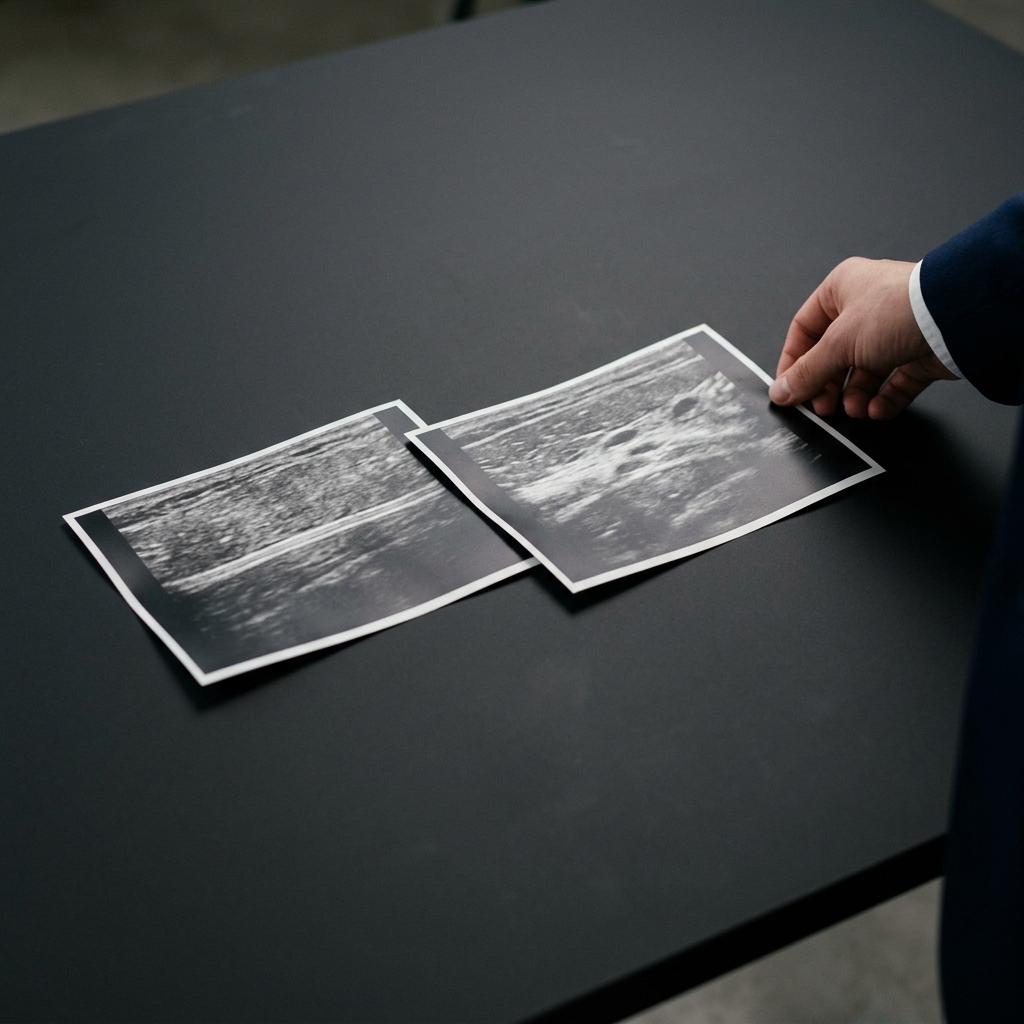
The two sheets, as they were placed on the table. Take a second before you read on.
He looks at them for a long time. He turns one of them ninety degrees, then turns it back.
Her scans were never normal because nothing was wrong. They were normal because nothing anyone ordered was built to look there.
"Then stop talking around it. Show me. "
She puts two objects on the table. One has been sitting in a dish of water. One has been out on a windowsill for a week. She hands him the dry one and asks him to bend it.
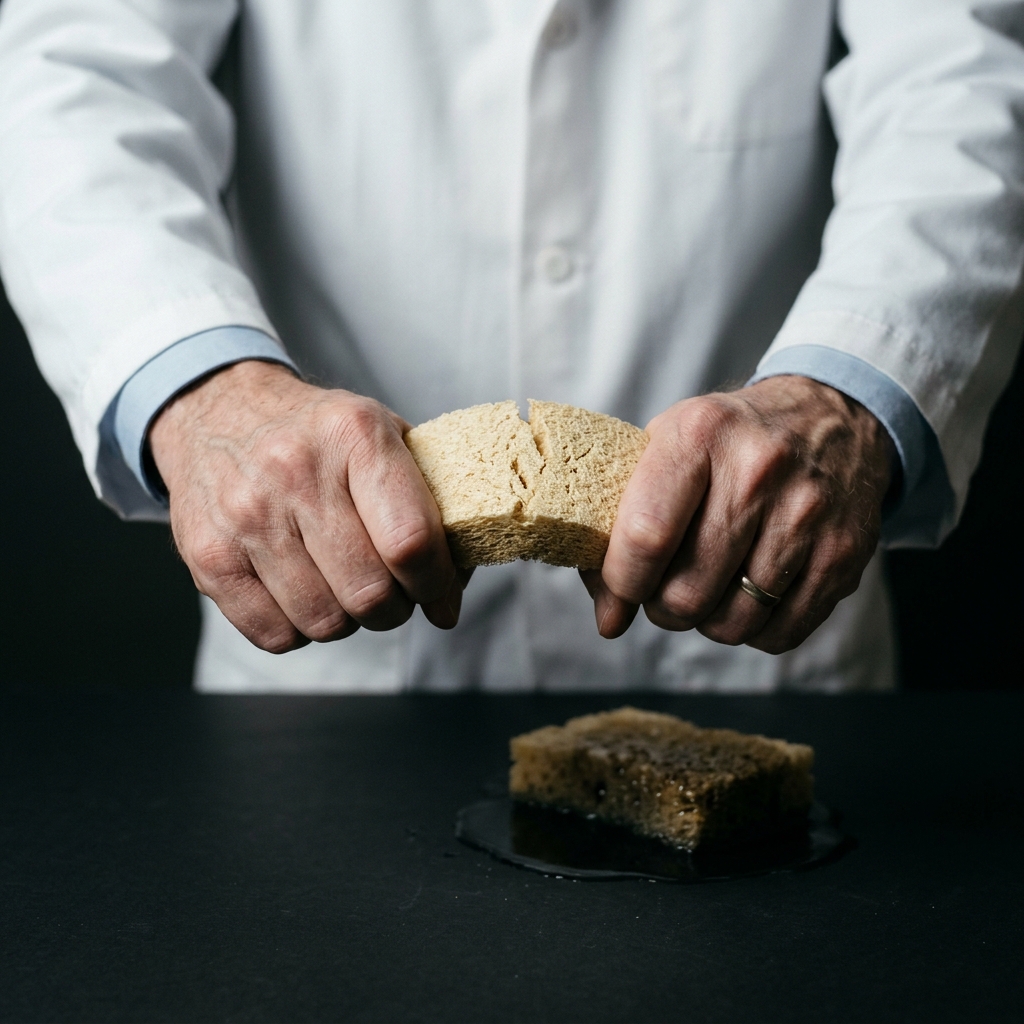
He uses both hands. The knuckles go white. It cracks before it bends.

" So name it. "
The tissue is called fascia .
It is the fluid, water-rich layer of connective tissue that sits directly beneath the skin and just above the muscles. It runs through the entire body as one continuous layer.
Almost every pain nerve a person has is embedded inside it.
In a healthy body it is soft, fluid and cushioning. A thick wet gel that moves with the body and protects the nerves running through it. But it does not stay that way on its own. It relies on a specific set of nutrients from the body to hold that state.

Nobody in his row says anything to that.
So how does something that ended nine years ago still hurt this morning?
Here is what the infection has to do with it.
When any pathogen takes root, the body goes into survival mode. The immune system mobilises. Energy demand spikes. And to fuel the response, the body starts sending more of its resources to the organs it cannot function without. The heart. The brain. The lungs.

For most women this is harmless. For some of them, the switch never flips back.
The body cannot make resources out of nothing. It can only move what it already has. And the biggest share of what gets moved is the flow of nutrients meant for the fascia.
For most women that is not a problem. A typical infection runs two to four weeks. Healthy fascia takes that without lasting effect. The infection clears, the supply resumes, everything goes back to how it was.
In a subset of women, the supply never resumes.
The infection ends. But something has been altered by the fight itself, and the signal to start feeding the fascia again is gone for good. From that point the tissue runs on a fraction of what it needs.
Deprived of what it needs to hold water, it starts to dry out. The thick wet gel loses the moisture that gave it that quality.
It thickens. It stiffens. It densifies.
In some women over weeks. In others over years. The endpoint is always the same: a hardened, compressed layer of tissue where a soft, cushioning one used to be.

For fifty years nobody looked. Then somebody put a probe on it.
None of this used to be visible. For fifty years it happened silently inside the bodies of women nobody was looking closely at.
In the last several years, researchers started looking.
Keller does not answer for a while. When he does, he says it to the table rather than to her.
The brain is not misinterpreting anything. The signal it is getting is completely accurate.
The pain nerves inside the fascia are being physically compressed by the stiff, densified tissue that has hardened around them.
What every fibromyalgia medication has spent fifty years trying to numb is a signal that was never wrong to begin with .

"Then why did nobody teach me this? "
For most of the last century, medical students were taught to think of fascia as packing material.
The thin whitish layer they were told to scrape away in dissection lab to get to the muscle underneath, which was assumed to be where the interesting biology lived.
Anyone who studied it seriously was fringe. Anyone who suggested it might be involved in chronic pain was ignored.
That has changed hard in the last several years. What used to be dismissed as filler is now recognised as one of the most sensory and most active tissues in the human body.
He was not taught to miss it. He was taught to throw it out.
Then Someone Sat Down

Thirty-one minutes in, a woman walked onto the floor and sat in the chair.
She is 54. She has had the diagnosis for nine years. Nobody in that room had asked her a single question yet.
They asked her to name the four things that bother her most.
She did not use one clinical word.
Why Every Symptom Finally Makes Sense
Once the finding is understood, the symptoms stop looking random. Not a dozen unrelated problems. One problem, showing up in four places.
When fascia is stiff and densified, every movement takes more energy than it should. Getting out of bed. Standing at the counter. Walking to the car. Every muscle is working against a layer of tissue that has hardened around it and refuses to give. By 10 a.m. a full day's worth of energy is already gone.
Healthy fascia is a cushion, a thick hydrated layer that absorbs pressure and buffers the pain nerves running through it. Densified fascia does the opposite. It is rigid and sits directly on top of those nerves, pressing down constantly. What used to land on a cushion now lands on hardened tissue that transmits every ounce of pressure straight into the nerves.
Fascia is what allows the body to bend, twist and reach through its full range. When it dries out and hardens, every movement runs into resistance from the inside. A stiffness that is worst in the morning but never fully lifts, no matter how much stretching, walking or moving is done.
The brain has a fixed amount of processing capacity. When the body is running with millions of compressed nerves throughout it, the brain is forced to spend a huge portion of that capacity managing pain signals it never had to before. Everything else, memory, focus, word retrieval, gets whatever is left. Which is not much.

Then They Emptied Her Bag Onto the Table
She had been asked to bring everything she takes and everything she uses. It took her two trips from the car.
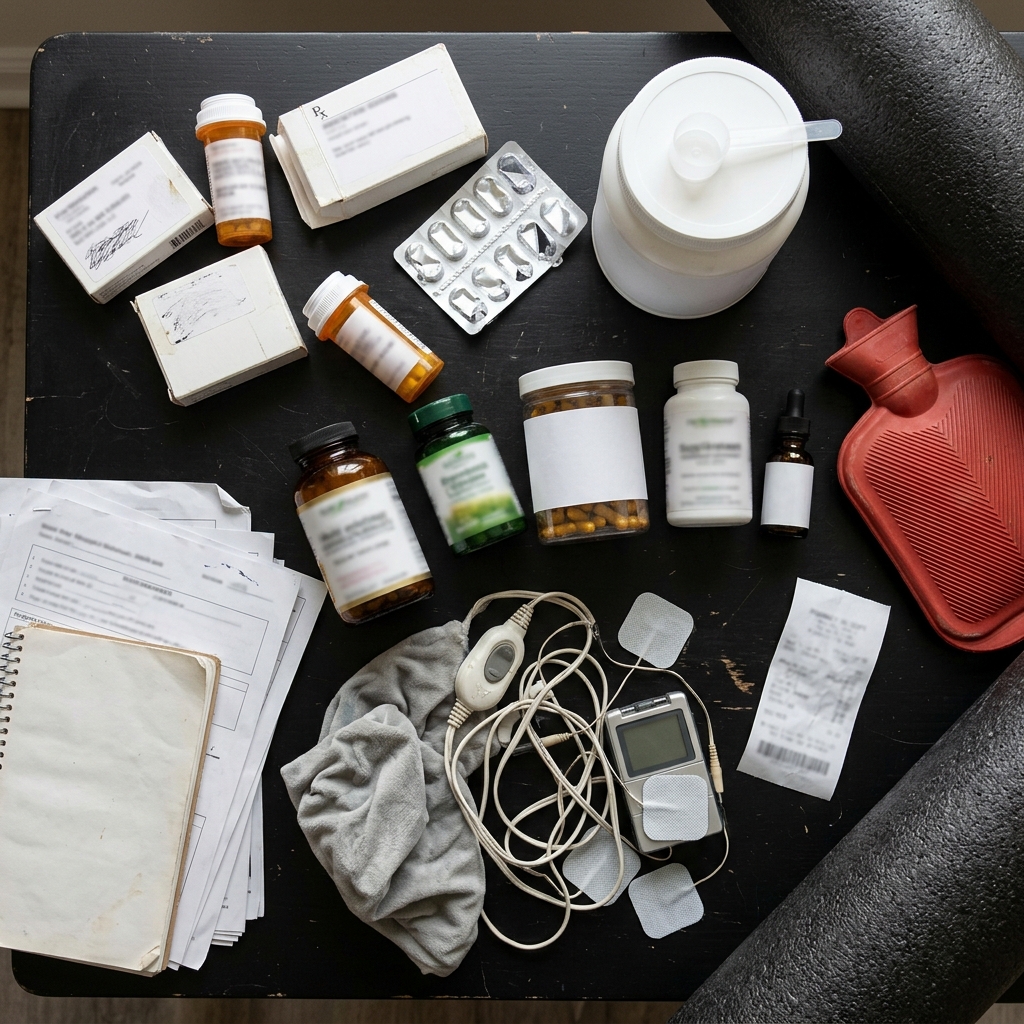
She picked up everything she had been handed in nine years. One at a time.
Marchetti picked them up one at a time, said what each one was aimed at, and set it off the table.
The nerve pain medication. It turns down the signal travelling along the nerve. It does not reach what is pressing on the nerve.
The antidepressant. It works on how the brain processes the signal. The signal keeps arriving.
The muscle relaxant. It makes the muscle let go for a few hours. The layer around the muscle does not let go with it.
Magnesium. Turmeric. The anti-inflammatories. Aimed at muscle and at general inflammation. Neither one is the state the tissue is in.
The heating pad and the TENS unit. They change what the nerve is reporting while they are switched on. Then they are switched off.
The worksheets. They help her carry it. They were never going to change it.
Then the table was empty.
Not one of those things is useless. Several of them are the reason she has been able to work. But not one of them was ever aimed at the tissue.
She had not been failing her treatment. Her treatment had been aimed somewhere else.

What Finally Reaches the Real Problem
If the tissue is the problem, what on earth actually reaches it?
Painkillers do not touch fascia. Antidepressants do not touch fascia. Physical therapy works the muscle beneath it, not the tissue itself. Every option on the market was built for a nervous system that was assumed to be malfunctioning.
The real answer is not more sophisticated. It is more fundamental.
The fascia has to be given back the specific natural compounds the body stopped sending it, the ones it needs to rehydrate, soften and become healthy again.
For most of the last fifty years none of this could have been acted on, because none of it was understood. It is only in the past few years that the research has caught up, mapping the mechanism and identifying the exact compounds the fascia needs. And even that was only half the battle. Several of those compounds are difficult to source and expensive to produce at the doses that matter. So despite everything the research had figured out, nobody had built a product around it.
The Turning Point Came in 2026
Until early 2026, no product on the market was built to do that.
The company that changed it is called Fascial Labs . It was founded by a small group of clinicians and researchers who had spent years working in fascia and connective tissue, watching women with fibromyalgia cycle through medication after medication that had never been designed for what was actually happening in the tissue. Rather than wait for a pharmaceutical company to build what the research had already made possible, they built it themselves.

The supplement they released in January 2026 is called TrueForm® , the first product ever formulated specifically to support fascial hydration and healthy connective tissue function.
Alongside the launch, Fascial Labs ran a 90-day observational study to see how women with fibromyalgia responded in a real-world setting. The cohort included 1,247 women with a clinical fibromyalgia diagnosis , all of whom had failed at least one FDA-approved medication for the condition before enrolling. The results were not what the researchers expected.

The Real-World Results, From Real Women
Over the first 90 days, the women in the cohort reported the following.

How Each Ingredient Supports the Fascia
TrueForm® was built around the specific compounds the research identified as central to fascial hydration, each one supporting a different part of the mechanism.

Safe with your current medications.
TrueForm® is compatible with every major fibromyalgia medication, Lyrica, Cymbalta, Savella and LDN included . Because the formulation is made entirely from natural ingredients, there are no known interactions, and no need to come off anything to begin. Most women start TrueForm® while still on their current prescriptions, then taper down over time as the fascia responds, with their doctor .
Anyone on a blood thinner should check with their doctor or pharmacist first, as with any new supplement. Anyone who is pregnant or breastfeeding should wait.
Most fibromyalgia interventions ask women to overhaul their lives to get a marginal result. TrueForm® asks for two capsules a day.
The results of the launch cohort left Fascial Labs with a straightforward decision .
If a formulation delivers meaningful change for a majority of women who had failed every other option they had tried, standing behind it should not be complicated. Any customer who takes TrueForm® for the full 90 days and does not feel a real difference by the end of it gets a full refund . No shipping the pouches back. No forms to fill out justifying the decision. No conditions.
The window mirrors the 90 days the cohort study covered, the same window in which the majority of women saw meaningful reductions in their pain, stiffness, fatigue and the rest of the symptoms they had lived with for years.
Why Starting Sooner Matters
Why does the same condition hurt a ten-year patient more than a one-year patient?
There is a reason a woman who has lived with fibromyalgia for a decade suffers more than one diagnosed a year ago. It is not that her body is weaker or that she handles it worse. It is that the fascia behind the condition has been densifying the entire time , and the nerves inside it have been compressed for longer.
Fascia does not rehydrate on its own. Left alone, it only continues to harden. Which means the state the tissue is in today is the easiest it will ever be to rehydrate , and every month that passes moves it further in the wrong direction.

Important — Please Read
TrueForm® Is Not Sold on Amazon
TrueForm® is only available at tryfascial.com . If it shows up anywhere else, it isn’t the real thing. Here’s what’s going on:
- Scammers have listed fake “TrueForm® supplements” on Amazon copying the name and logo.
- These counterfeits are made in China and don’t contain the actual TrueForm® ingredients.
- Many are never shipped at all — buyers are charged and receive nothing.
- Unfortunately, real customers have already been scammed this way.
- Fascial Labs is actively working to get these listings removed.
The genuine, USA-made TrueForm® is sold in one place only: tryfascial.com
From Women Who Had Given Up on Feeling Better

I've been on this since February. The aching is better too, but the brain fog is what shocked me. About six weeks in I noticed I could actually follow a conversation without losing the thread halfway through. My head feels clearer than it has in years.

I'm glad I finally did. I am back to my morning walks, I am keeping up with my grandkids, and I wake up looking forward to the day instead of dreading it. At my age I did not think anything could shift this much.

Started this in March. Somewhere around the two month mark I noticed the seatbelt didn't bother me the way it used to, and then I realized I'd stopped bracing when my husband hugged me. It's hard to describe how much that means.
Practitioner allocation first.
The last thing worth knowing is that TrueForm® is not always in stock.
It is manufactured in small clinical batches in an FDA-registered, GMP-certified facility in the US. A portion of every batch is reserved for the 500+ rheumatologists, pain specialists and PM&R physicians distributing it within their practices. Whatever remains is released to the public, first-come, first-served.
When a batch sells out, the next one takes six to eight weeks to produce, and women already on the protocol are placed ahead of new customers for restocks.
But if TrueForm® is in stock, this is an invitation to join the thousands of women who are already on it.
Scientific references. 1. Bergen Giardia Cohort Studies, Scand J Pain. 2. Ursini F et al., Inflammopharmacology, 2023. 3. Buskila D, Atzeni F, Sarzi-Puttini P, Autoimmunity Reviews, 2008. 4. Liptan GL, Journal of Bodywork & Movement Therapies, 2010. 5. Gromakovskis V, Frontiers in Pain Research, 2025. 6. Pavan PG, Stecco A, Stern R, Stecco C, Current Pain and Headache Reports, 2014.
About this session. The panel discussion described in this article is a dramatisation created for this publication. The specialists are composite characters and are not real individuals. The research findings, citations and figures referenced within it are real and are listed above.